How to Determine Whether an FIPFG Bead Meets Quality Requirements
FIPFG Quality Inspection Guide
How to Determine Whether an FIPFG Bead Meets Quality Requirements
A reliable FIPFG foam sealing bead should be continuous, dimensionally consistent and firmly joined at the start and end points. WINMAN provides this practical inspection guide for engineers, production teams and quality specialists evaluating bead uniformity, stable joints, local defects, interrupted dispensing and uneven foaming.
What defines an acceptable FIPFG bead?
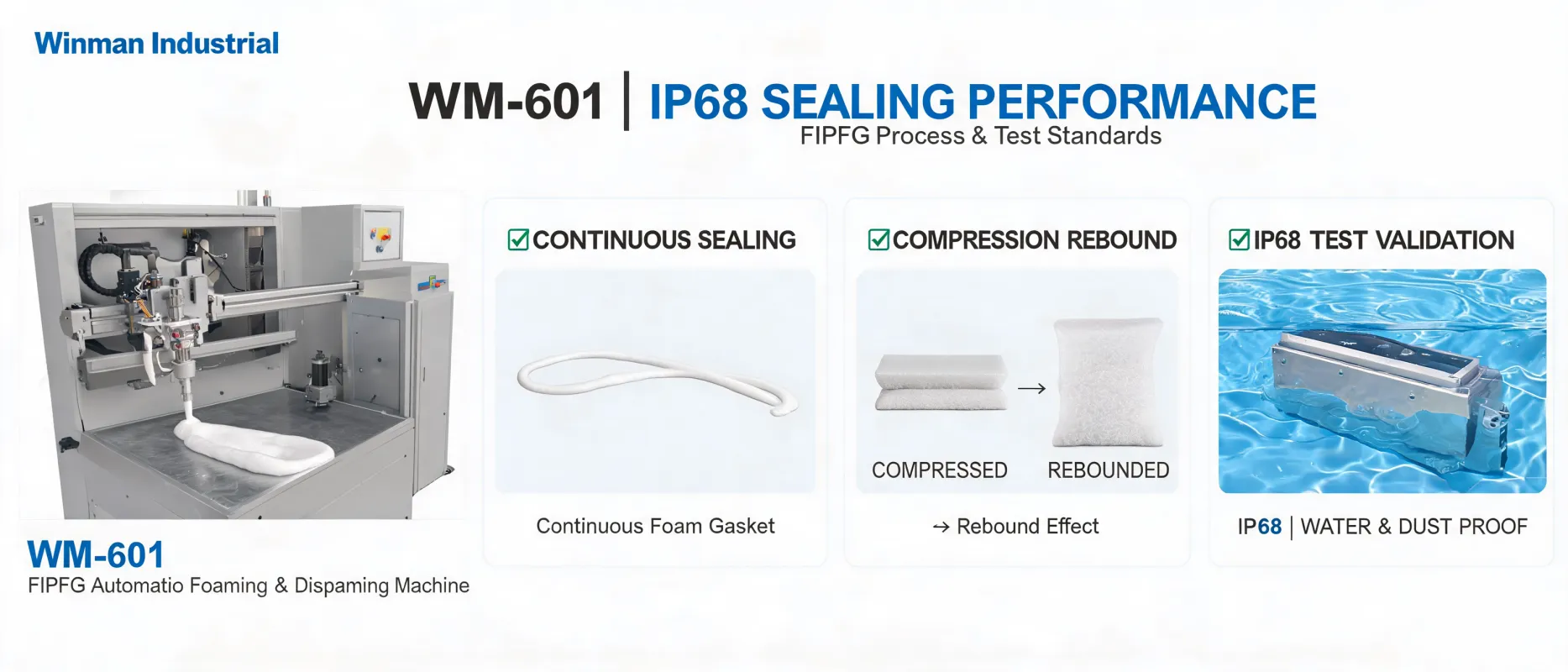
Acceptance should be based on the component drawing, sealing specification, material requirements and the validation method defined for the application. In general, the bead should follow the intended path without visible interruptions, excessive variation, open joints or areas of collapse. For applications requiring IP67 protection, bead inspection should be combined with the appropriate finished-assembly sealing or leak-validation test.
Five key inspection points
Bead uniformity
Check whether the bead maintains a consistent width and height along the complete dispensing path.
Joint stability
Inspect the beginning and end of the bead for a complete, stable connection without a visible gap or excessive overlap.
Local defects
Look for collapsed sections, bubbles, voids, excessive spreading, contamination or damage caused during handling.
Dispensing continuity
Confirm that the material is dispensed continuously and that no short shots, breaks or unplanned stops appear on the route.
Foaming consistency
Evaluate whether the bead expands and cures consistently, without obvious differences in cell structure, density or surface condition.
Practical FIPFG bead quality checklist
| Inspection item | What to check | Typical concern |
|---|---|---|
| Route and position | The bead remains within the specified sealing channel and does not interfere with assembly features. | Offset, overspray or insufficient edge coverage. |
| Width and profile | The bead profile is stable and corresponds to the selected process specification. | Uneven width, excessive flattening or local thickening. |
| Continuity | There are no visible breaks, missing sections or unfilled corners. | Interrupted dispensing or an incomplete sealing path. |
| Start and end joint | The joint is closed and stable, with a controlled transition between the beginning and end of the route. | Open joint, excessive buildup or weak connection. |
| Foam condition | The cured bead presents a consistent appearance and remains attached to the designated substrate. | Collapse, voids, irregular expansion or adhesion loss. |
Recommended inspection workflow
-
1
Confirm the reference.
Review the part drawing, sealing path, specified bead dimensions, material and acceptance criteria before inspection. -
2
Inspect the uncured or freshly applied bead.
Check route accuracy, continuity, width variation, corners and the start-end joint under suitable lighting. -
3
Inspect after foaming and curing.
Look for local collapse, uneven foaming, surface damage, voids and adhesion problems that may not be visible at the initial dispensing stage. -
4
Verify the finished assembly.
For critical enclosures such as electronic housings, battery-related components and control cabinets, combine visual inspection with the required functional or sealing validation.
Common causes of bead defects
- Incorrect positioning, path data or workpiece fixation can cause route deviation.
- Unstable material supply or unsuitable process conditions may lead to interrupted dispensing.
- Inconsistent component ratio or mixing can affect foam structure and bead uniformity.
- Poorly controlled start and stop movements may create an open or oversized joint.
- Surface contamination, unsuitable substrate preparation or handling may reduce adhesion.
How WM606 supports consistent FIPFG inspection results
The WINMAN WM606 FIPFG foam sealing machine is designed for precision sealing of fine electronic housings and miniature sensors. Its process features provide useful control points when establishing a repeatable bead-quality inspection method:
A quality decision should combine appearance and performance
Visual inspection is an important first step, but it should not replace application-specific validation. By linking bead uniformity, joint stability, dispensing continuity and foaming consistency with defined production criteria, manufacturers can create a clearer and more repeatable FIPFG quality assessment process. Shanghai Winman Industrial Co., Ltd. supports customers with WINMAN sealing equipment and technical expertise for precision sealing applications across electronics, automotive lithium batteries, photovoltaic equipment and industrial manufacturing.

Hot Products


Popular articles