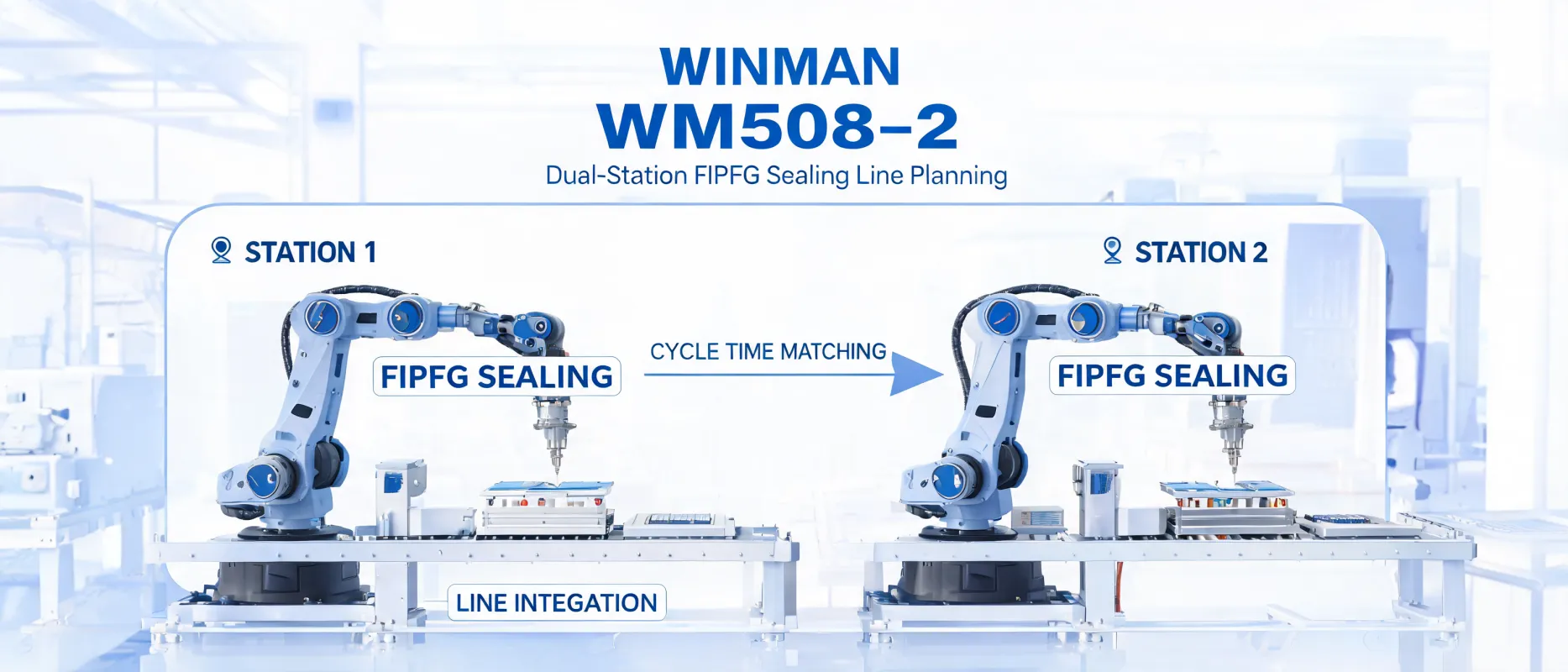
For a reliable WM508-2P ROI assessment, Winman Industrial recommends calculating performance from actual production conditions rather than theoretical dispensing speed alone. Daily output, labor savings, and sealing rework reduction should be evaluated together with the complete production flow, including dispensing, handling, curing, and testing.
Daily output estimation should begin with the real gasket path length and the applicable dispensing speed. The calculation should then include the time required for part loading and unloading, as well as the operating schedule of each shift.
To avoid overstating capacity, account for planned and unplanned production factors, including:
The practical output is determined by the slowest relevant step in the production process. Even when dispensing capacity is sufficient, downstream curing or testing takt may define the actual number of completed parts per day.
Labor savings should be measured against the current production method and staffing arrangement. Review how many operators are currently involved in sealing preparation, application, inspection, handling, and rework activities.
A meaningful labor savings analysis should use actual labor cost and staffing data, then compare the required operating labor after implementation of the WM508-2P system. This approach provides a more realistic assessment than basing savings only on machine cycle time.
Sealing rework reduction should be linked to the existing causes of defects, rather than assumed from automation alone. Identify current defect causes, such as inconsistent bead application, process variation, or inspection failures, and establish the present rework rate.
Then validate dispensing consistency through production trials. Comparing trial results with current defect and rework records helps determine whether the FIPFG process can reduce rework under the actual part design, material, and production conditions.
Key evaluation principle: Use actual gasket path length, dispensing speed, loading time, shift schedules, changeovers, OEE, and downstream curing and testing takt to estimate output. Validate labor reduction and rework savings using current staffing, labor cost, defect causes, and real dispensing consistency trials.